
by Mattie Lawson, Client Delivery Specialist at Atticus

Why Major Gift Fundraisers Should Think Beyond the Checkbook
Making a major gift ask can be daunting, even after months of building a relationship with a donor. You’ve done your research, you understand their connection to your mission, and you have a gift amount in mind. But when the conversation turns to making a commitment, there may still be uncertainty about how they’ll respond.
Perhaps you’re meeting with a longtime, generous donor who has been deeply connected to your organization’s mission for years. You might be confident they have the capacity to make a six-figure commitment, but when you bring up the gift, they hesitate and say, “Cash is a little tight right now.”
It can be tempting to interpret the hesitation as a sign that your ask was too ambitious. But perhaps they mean exactly what they said: cash is tight. And the answer may not be to lower your ask or postpone the conversation. You may simply need to reframe it. You might respond with something like:
“That makes sense. Would it help to think about funding this gift from something other than cash?”
The question isn’t always whether a donor can give more. Sometimes it’s whether there’s a different way for them to give.
The Opportunity Beyond Cash Gifts
Major gift fundraisers spend considerable time evaluating giving capacity, determining appropriate ask amounts, and identifying donors ready for a larger commitment. But a donor’s net worth and their available cash are two very different things.
Wealth can take many forms beyond checking and savings accounts. A $10 million net worth doesn’t necessarily mean $10 million in cash. The wealth could include a business, investment accounts, real estate, and retirement savings with only a fraction in cash.
Research suggests there’s a meaningful fundraising opportunity in thinking beyond cash.
In a study of more than one million nonprofit tax returns, Texas Tech University professor Russell James examined the relationship between non-cash gifts and fundraising growth. His findings compared five-year contribution growth among nonprofits receiving different types of gifts:
-
11% growth among organizations receiving only cash gifts.
-
50% growth among organizations receiving non-cash gifts, including property and deferred gifts.
-
66% growth among organizations receiving gifts of securities.
For development teams, the implication is worth considering: If your major gift conversations focus exclusively on cash, you may be overlooking resources donors could use to support your mission.
How a Donor Gives Can Matter as Much as How Much They Give
Whether you’re cultivating a new prospect or working with a longtime supporter, understanding a donor’s philanthropic goals is essential. What do they hope to accomplish through their giving? What impact matters most to them? And how does philanthropy fit into their broader financial priorities?
Those priorities can influence not only the amount someone wants to contribute, but also how they choose to fund that commitment.
For donors with significant investments or other assets, a non-cash gift may allow them to preserve cash for other needs. Some may also be interested in the potential tax advantages of contributing appreciated assets.
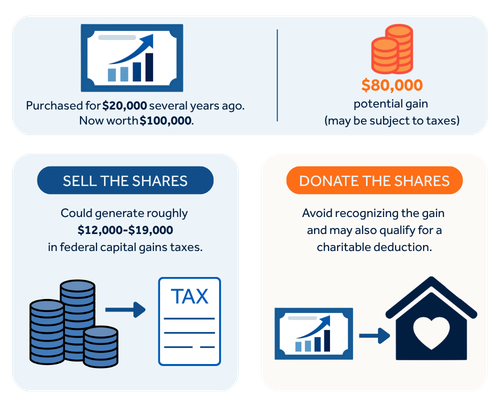 Take appreciated stock as an example. Shares purchased for $20,000 several years ago may be worth $100,000 today, but selling the shares would generally realize an $80,000 capital gain that may be subject to taxes. Donating eligible, long-term appreciated shares directly to a qualified charity can help avoid recognizing that gain and may also qualify for a charitable deduction. If the donor sells the shares, that $80,000 gain could generate roughly $12,000–$19,000 in federal capital gains taxes, depending on their tax situation. Instead, if they contribute the shares directly, the organization can receive the full $100,000 value without the donor first paying capital gains tax on the appreciation.
The specific benefits depend on the donor’s circumstances and applicable tax rules, but the main point is simple: Financial considerations can look very different depending on how a gift is funded.
Tax benefits aren’t the starting point for a philanthropic relationship—a donor’s connection to the nonprofit’s mission and desire to make a difference should lead the conversation—but understanding broader goals and financial considerations can help identify giving options that support those intentions.
And, in some circumstances, a more efficient way to give may make a larger commitment possible.
Shift the Conversation From "How Much?" to "From What?"
Once you understand a donor’s philanthropic goals, the next step is to expand the conversation beyond the gift amount.
Think about a potential major gift in three dimensions:
-
How much? What level of philanthropic commitment aligns with the donor’s interests and your organization’s needs?
-
From what? What resources might the donor consider using to fund that commitment?
-
When and how? What timing or gift structure could make the commitment practical?
This approach doesn’t require asking donors to disclose their investment portfolios or provide detailed financial information. It simply creates room to discuss options they may not have considered.
It’s important to begin with a donor’s goals rather than jumping straight into financial details. What do they want to accomplish in both the short and long term? Knowing that before exploring the resources that might help them get there is a helpful place to start.
For MGOs, that might mean asking:
“Some donors find it easier to fund a gift like this from investments rather than cash. Is that worth exploring?”
Or:
“As you think about your giving goals over the next few years, are there different ways of funding those commitments you’d like to explore?”
If a donor has already expressed interest in a significant gift but seems hesitant about how to fund it, you might ask:
“Would it be helpful to explore some options with your financial advisor before deciding how to structure the gift?”
These questions don’t pressure the donor to reveal more than they’re comfortable sharing. Instead, they open the door to a more thoughtful conversation about what might work for them.
Recognizing Opportunities for Non-Cash Gifts
Sometimes, the chance to discuss non-cash giving emerges naturally during cultivation. A longtime supporter might mention retirement or a change in investment strategy. Another donor may own multiple properties or be preparing to sell one. Even a comment like “Cash is a little tight right now” can be an opportunity to ask a follow-up question rather than immediately reducing the gift amount.
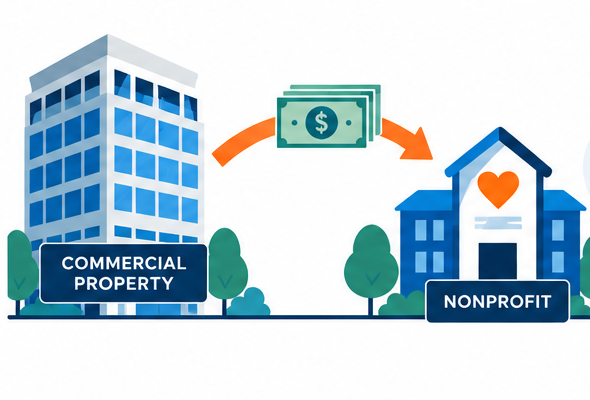
Non-cash major gifts can look very different depending on the donor’s circumstances. For example, one donor contributed a 25% ownership interest in a commercial rental property to a nonprofit. Rather than making a traditional cash gift, the donor transferred a portion of an income-producing asset. The arrangement allowed the nonprofit to receive regular cash flow from rental income generated by its ownership share. The organization also held an ownership interest that could potentially appreciate in value, creating another possible source of future funding. A gift like this requires careful gift-acceptance review, including consideration of the property’s liabilities, ongoing expenses, and responsibilities associated with partial ownership.
 Other non-cash contributions can be more straightforward, such as publicly traded stock, which nonprofits can often receive more easily with the right brokerage arrangements. Eligible mutual fund shares and certain privately held business interests may also be options.
For donors age 70½ and older, qualified charitable distributions (QCDs) can be another simple way to give without dipping into cash savings. Instead of withdrawing money from an individual retirement account (IRA) and then donating it, donors can transfer funds directly to an eligible charity. The amount transferred is generally excluded from taxable income and can also count toward their required minimum distribution (RMD), if they have one. While QCDs don’t qualify for an additional charitable income tax deduction, they can be a tax-efficient way for donors to support causes they care about.
You don’t need to know every type of asset that could potentially be donated. What matters is recognizing opportunities to explore how a donor’s resources might support their philanthropic goals.
Turn Donor Intelligence Into Better Conversations
 Identifying these opportunities starts well before the ask.
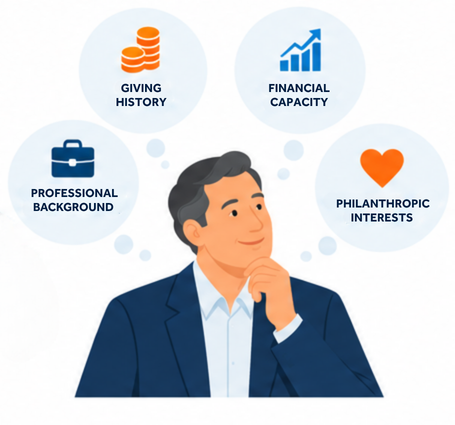
Understanding a donor’s giving history, financial capacity, professional background, and philanthropic interests can help you prepare for a more informed conversation. But donor intelligence isn’t simply knowing someone has substantial wealth.
It’s knowing how to use that information to guide cultivation.
Learning that a prospective donor owns a business may prompt you to explore how their business interests and long-term plans intersect with their philanthropy. Knowing that a longtime supporter has significant investment holdings might encourage you to introduce the possibility of an appreciated-stock gift. Asset ownership doesn’t guarantee availability, but it can open the door to a conversation.
Though these aren’t guarantees of a gift, they do help you ask more relevant questions and develop an informed, personalized solicitation strategy.
The same thinking applies to managing a major gift pipeline. If a donor is interested in a significant commitment but needs time to consult an advisor or consider an alternative funding source, that isn’t necessarily a stalled opportunity. It may be the next step in moving the relationship forward.
Documenting those conversations, identifying the next action, and adjusting the expected timing of a gift can help development teams maintain momentum while keeping their revenue expectations realistic.
Good donor intelligence should do more than inform an ask amount. It should help you decide what conversation to have next.
You Don't Have to Be a Financial Advisor to Have the Conversation
One reason fundraisers may hesitate to discuss non-cash giving is that they don’t feel qualified to talk about investments, taxes, or complex assets. But MGOs aren’t expected to be CPAs, attorneys, or financial advisors. It’s not your job to recommend specific tax strategies or calculate deductions. Your role is to recognize opportunities and know when to bring other professionals into the conversation.
With the donor’s permission, involving their trusted financial advisor or CPA can be especially valuable. An advisor who understands the donor’s philanthropic goals can consider those goals alongside their other financial priorities. The nonprofit can help communicate the impact the donor hopes to make and the types of gifts the organization is prepared to receive.
An organization equipped to accept publicly traded securities may lack the expertise or resources to evaluate a commercial property or a privately held business interest. Development teams should understand their organization’s gift-acceptance policies, internal approval processes, and the documentation requirements for non-cash contributions.
You don’t need to have every answer. You need to know which questions to ask and when to bring others into the conversation.
Don't Let the Funding Source Limit the Conversation
Understanding a donor’s giving capacity has always been about more than identifying a number. It’s about understanding the person behind that number: their interests, financial circumstances, priorities, and reasons for giving. 
That understanding becomes even more valuable when you look beyond cash.
A donor who isn’t comfortable making a six-figure cash gift may still be interested in a commitment funded another way. A donor who has never considered giving appreciated assets may welcome the chance to explore an option that better fits their financial plans.
For development teams, recognizing those possibilities requires more than identifying wealthy prospects. It means using donor intelligence thoughtfully, asking questions that uncover what matters to each donor, and following through as new opportunities emerge.
The next time a donor hesitates at an ask, consider whether the amount is really the obstacle—or whether the way you’ve framed the gift is part of the problem.
Sometimes, the most useful follow-up isn’t
“How much could you give?”
It’s
“Have we considered how you’d like to give it?”
That one question could change the conversation’s direction—and reveal a giving opportunity neither of you had previously considered.
Questions to Keep in Your Back Pocket
Before the ask (discovery):
- “Are there different ways you’d like to fund those goals?”
- “Have you ever made a gift from something other than cash, like stock or an IRA?”
When the donor hesitates:
- “Would it help to think about funding this gift from something other than cash?”
- “Some donors find it easier to give from investments. Is that worth exploring?”
- “Would spreading this over several years make it more workable?”
Bringing in their advisors:
- “Can we send your advisor a short summary of the gift types we accept?”

